Our Freedom Is Not at Stake
by Laynie Soloman, Associate Rosh Yeshiva

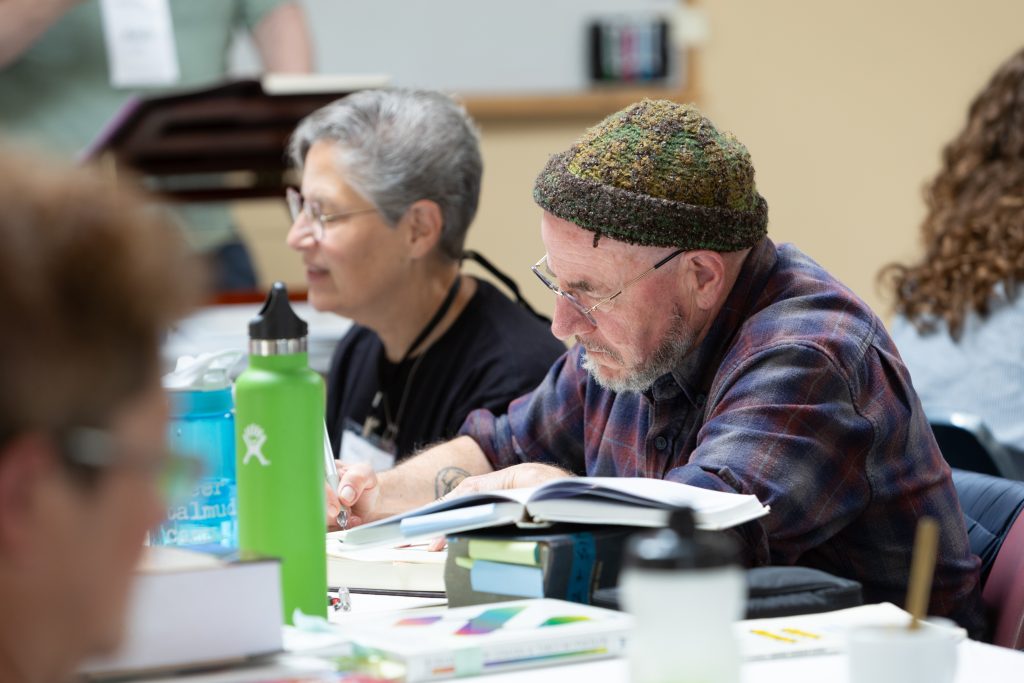
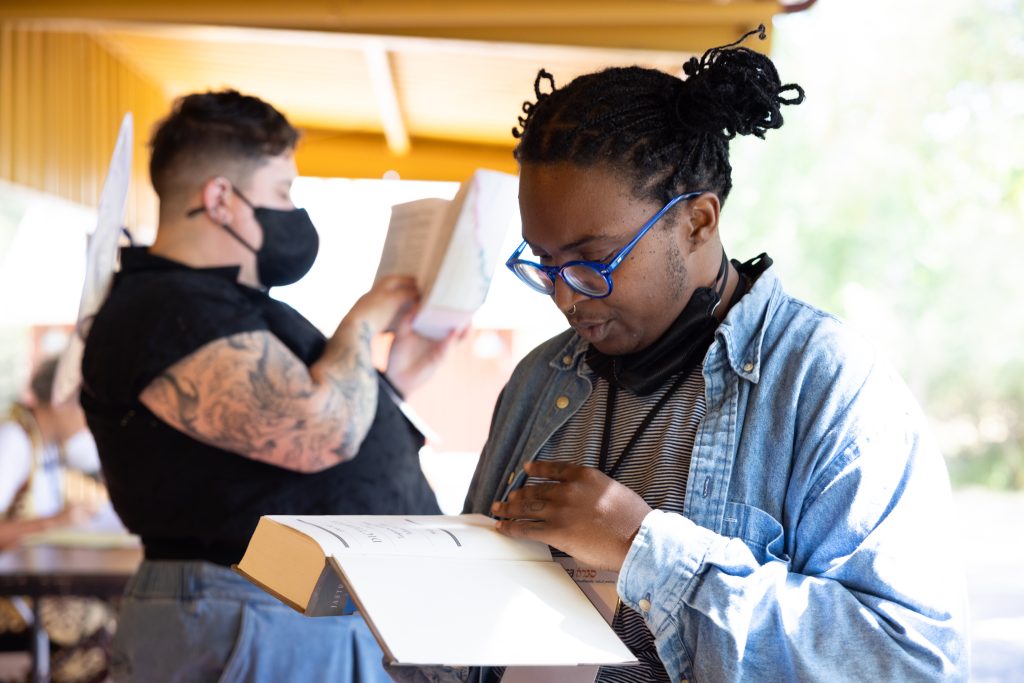
Last Tuesday night, our class gathered as usual: ready to read, interpret, and make meaning from a sugya in Bava Batra. It was hard to put into words the precise reason that our teaching team created the option to gather on a night that was full of anxiety, fear, anger, and tension for so many of us in the bet midrash. But we felt in our kishkes that making space to learn Torah together on Tuesday night could do…something.
In moments like this, when faced with the question of coming together to learn or canceling class to make space for the big feelings of being in this world, I come back to the same question: Why learn Torah when the world around us feels like it is collapsing? The answer is, in some ways, one of the guiding principles of our yeshiva: we learn Talmud because it offers us—in form and in content—a blueprint for how to pull ourselves and our tradition through moments of personal, political, and spiritual catastrophe, as Rabbi Benay teaches so timelessly in the CRASH Talk.
But even so, I’ve struggled to make sense of my own love for learning in the midst of political upheaval, increased violence and suppression, and the fear that our rights and the rights of others might disappear. Isn’t there always something more important to do that could have material impact?
Throughout this year, I have found a teacher in one of our great sages, Rabbi Aharon Samuel Tamares, of blessed memory, a prolific Torah scholar and pacifist who taught in Poland during the late 19th and early 20th centuries. His work came into my life through the recently published translation of his essays by Rabbi Everett Gendler, z”l).
In a 1918 essay, “The Freedom of Torah & the Arrogance of the Sword,” (part of a larger work, Keneset Yisra’el U-milkhamot Ha-goyim, “The Collective of Israel and the Wars of the Nations”), Tamares writes, “Freedom can only be inherited by an Exiled people with Torah.” With this radical statement, Tamares argues that it is possible, even in our most powerless moments, to be truly liberated. Exile—the condition that removes us from accruing ultimate political power—makes us keenly aware of the tenuousness of our political freedom as we live under the rule of dominant Empire, and requires that we recognize the source of our true freedom that pervades regardless of our political conditions: the Torah and God.
R’ Tamares finds support for this statement in a mishnah that has become quite beloved here at SVARA, having been drashed about beautifully by R’ Mónica Gomery here, Pirkei Avot 6:2:
וְאוֹמֵר (שמות לב) וְהַלֻּחֹת מַעֲשֵׂה אֱלֹהִים הֵמָּה וְהַמִּכְתָּב מִכְתַּב אֱלֹהִים הוּא חָרוּת עַל הַלֻּחֹת, אַל תִּקְרָא חָרוּת אֶלָּא חֵרוּת, שֶׁאֵין לְךָ בֶן חוֹרִין אֶלָּא מִי שֶׁעוֹסֵק בְּתַלְמוּד תּוֹרָה.
And it says, “And the tablets were a work of G!d, and the writing was the writing of G!d, engraved upon the tablets” (Exodus 32:16). Do not read [the verse] as harut [‘engraved’] but heirut [‘freedom’]. For there is no free person except one who immerses in the practice of studying Torah.
On its own, this mishnah exemplifies all that we love about the Rabbis. A bold and creative re-reading of the Torah verse establishes a fundamental connection between Torah and heirut—freedom or liberation. Don’t let the translation get you twisted here: heirut (from the root חור gives us something like “clear” or “transparent” as a close inside) does not mean the kind of “free” that we often associate with the term—free items don’t cost anything, free time means time to do whatever we want, and freedom typically carries with it a sense of autonomy and agency, granting us the capacity to choose, decide, or act of our own volition.
Tamares helps us get at this deeper sense of freedom in the Mishnah, clarifying what it is and what it isn’t:
This mighty dictum of the Mishnah, which not only relates the patter of freedom to Torah but decisively rejects all other kinds of freedom except the freedom of Torah, surely establishes at least this: that the concept of freedom is not something shallow or superficial, but rather a deep issue which requires considerable reflection; and that freedom in the modern sense, heard on every lip today, is not only far from the real meaning of freedom but quite another matter altogether.
In short, freedom according to [modern political notions] is something which needs to be gathered from the “outside.” Even socialism, which is so far advanced in its ideas of liberty and freedom as to have formulated its well known proclamation, “freedom is not given but taken,” despite this also agrees that freedom is held in the hands of others and that it must be released and taken from those others.
R’ Tamares teaches that “freedom,” heirut, has a specific meaning: is not the same as having the capacity or ability to do something. The freedom we find in Torah, according to Tamares, is therefore not exclusively about achieving political emancipation and acquiring rights (though, I do believe he would appreciate that they are deeply important); the material rights and capacities granted to us benevolently by states are not the same thing as real liberation.
He continues:
All the while, true freedom (explains the Mishnah, which has penetrated deeply into the matter) is a man’s inner freedom. True freedom rests in man’s own hands. That is to say, when a man’s eyes are opened to recognize his own essence and self, he is already free, and he needs no further declaration of independence or formal emancipation from others. “Self awareness” is, therefore, not the mere preparation for freedom but the very freedom itself.
But this also must be realized: the self-recognition of the Mishnah is not that of modern [politics]. The latters recognition is of independent pride and daring, resting on no base or reason other than that of “ability:” I am permitted to free myself and I must free myself because I am able to free myself. The Mishnaic self-recognition, on the other hand, does indeed include the recognition of dependence—on Him Who spoke and the world came into being—and it is clearly conditional to man’s attaching himself to his Creator and making evident his form and image, the Divine image within him.
And since this attachment comes about only through concern for Torah, correctly did the Mishnah assert: “No man is free except one who engages in the study of Torah.”
Our freedom, and our liberation, are not things to be granted to us by others. The freedom that we find and create together through our learning is not the same as winning freedoms and rights that are tossed around in a presidential debate or that can be granted or taken away at the whims of political leaders. The promise of freedom offered to us by the Torah is not given to us by states—it is up to us and our Creator.
Of course, Tamares does not (G!d forbid) declare material wins we achieve through our organizing as irrelevant or bad—they are, of course, essential: we should not surrender the material conditions of our and other people’s lives to the whims of the state. Our organizing should not lead us to narrow our scope of liberation by perpetuating an understanding that freedom is something that belongs in the hands of others. But what his teachings offer us is a lens through which to grapple with the rising authoritarianism in our midst, which will undoubtedly be accompanied by losses even as we fiercely resist: our wins and our losses do not determine whether we are liberated. Liberation is accessible to all of us all regardless of our political conditions and is a result of our having been created betzelem elohim, impressed with the Divine—a truth that we can understand fully when we immerse ourselves in Torah and allow it to work our hearts.
When we move through the world this way, we can resist with the awareness of what is truly at stake, and we know that our losses pose no threat to our true freedom.
I am deeply scared of what’s to come. But reading these words in the wake of the election, preparing for the impact of a Trump presidency and how it will escalate existing catastrophes and likely create new forms of turmoil and authoritarianism, has helped me tap into the Grounding Force that animates our movements: that we are already free.
When we gathered for shiur this Tuesday, the world was both the same and different. But regardless, Torah was there to help us find our freedom. As we continue into a new set of unknowns this season, I hope we find ways to use Torah for this right purpose: to free ourselves and create the conditions for others to do the same.